

It’s been another year of births, deaths and a fight for survival for B.C.’s endangered southern resident killer whales.
According to the latest census from the Washington-based Center for Whale Research, the population stood at 74 as of July 1, up just one from last year’s 73.
The modest increase underscores a fragile future for a species still in “overall decline,” whose population has been hovering around the low- to mid-70s for several years, says research director Dr. Michael Weiss.
But the number doesn’t tell the whole story, he adds – to understand what's really happening, you have to look below the surface.
During the census period, one adult male known as K26 – missing since the summer of 2024 – was confirmed dead. His death is a major loss for the population, Weiss says, as he was a reproductively viable male, with his son J51 now reaching sprouting age.
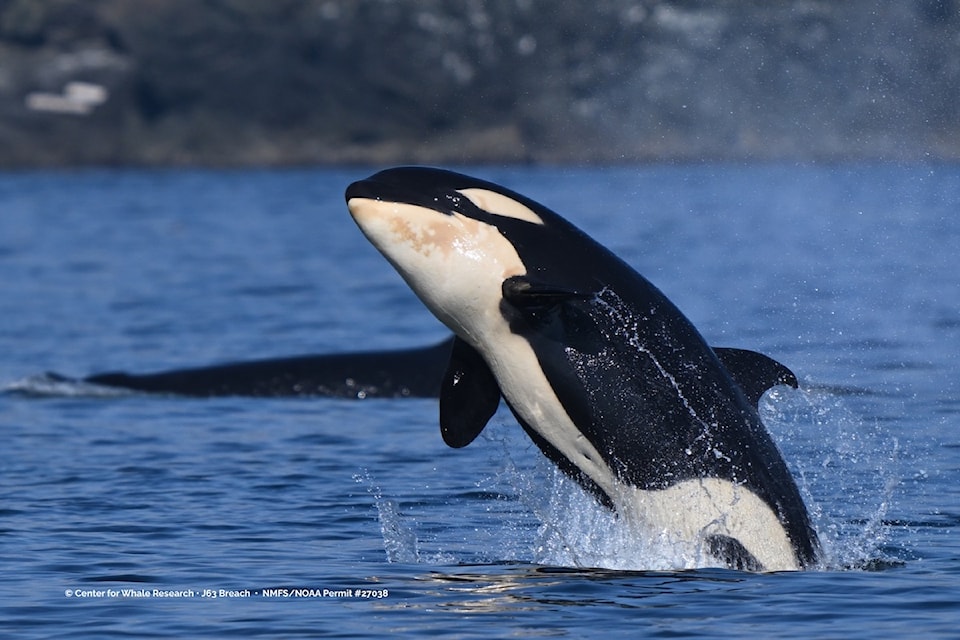
Four births were also documented across the year – three in the social group known as J pod, and one in L pod. Of those four, only two females, J62 and J63, survived to the July 1 census.
Diving deeper, each of the three pods – J, K and L – has a different story of survival to share.
While they have been in decline for several years, Weiss says L pod appears to have reached a plateau at 33 members.
For K pod, with just 14 whales, the outlook is far more dire. Along with the loss of K26, the pod has not seen a viable calf born since 2022.
“And that’s the only viable calf that’s been born in the last 10 years,” said Weiss. “Really, at this rate, K pod is on a path toward decline and extinction.”
Only J pod shows signs of growth, with what Weiss calls a “closer to normal birth rate” and no adult deaths in recent years.
“That could change very, very quickly,” said Weiss. “So our one growing pod is still a fragile growth, and the other two pods aren't showing any signs of growth.”
This year marks the 50th annual census of the southern residents. When the first count took place in 1976, the population stood at 71 – only slightly lower than today’s number.
But that early figure came shortly after the end of the marine park captures that decimated the population through the 1960s and 1970s, when more than 50 individuals were taken into captivity, some of them dying during the process.
Before the captures, Weiss says, the southern resident population is believed to have exceeded 100 individuals.
“There was a growth in population through the 1990s … we had nearly 100 individuals again,” he says. “But since then it's really been mostly a decline.”
Today, the whales continue to face three primary threats: toxic pollutants, underwater noise disturbance, and an overall decline in the abundance and quality of their primary prey species, chinook salmon.
Of those, Weiss says improving access to chinook is the most critical.
With an 18-month gestation period and a roughly 50 per cent calf survival rate, chinook is especially important for females.
Females unable to successfully reproduce often show signs of prolonged nutritional stress, explains Weiss. “We're not necessarily talking about starving, but not being able to find enough food to ward off diseases and to successfully gestate and nurse a calf.”
Restoring spawning habitat and adapting fishing methods to help target populations that aren't struggling are key to helping chinook numbers increase. But real change, says Weiss, comes through collective political action.
“These are big, systemic problems,” he says, encouraging folks to contact their local representatives. “Use your voice and your political will and your vote to make sure the people in power who represent you and your community are people who take the environment seriously.
“And if you see a habitat restoration effort in your area that needs volunteers, go out and plant some trees and help make a river healthier."
Despite the challenges, Weiss still sees room for optimism.
“The situation is dire, but it is not hopeless,” he says.
With a holistic approach to address the whales’ three main threats, experts believe there is a path back to a population of over 100 southern resident individuals.
“Not immediately – these whales are slow reproducing – but over the course of several decades,” says Weiss.
“From what we know about these animals … they will take the chances that they're given. So given the opportunity to thrive – and by that I mean greater access to the prey that they are biologically and culturally specialized on – I think they can take that chance and they could bounce back.”
Another reason for hope came in mid-September with the sighting of J64 – a newborn calf with first-time mother J42.
The new arrival wasn’t included in the July census, but Weiss says the Center for Whale Research team is “cautiously optimistic” about its survival – and particularly encouraged that J42 was able to give birth at all.
“There are concerns about inbreeding in this population, and she's kind of the poster child for it – her brother is also her father,” he says. “So just the fact that she's capable of reproducing, honestly … I’m taking the wins where I can get them.”
Weiss also notes that he believes there are “a few” females suspected to be pregnant. But as “most pregnant females never show up with a calf,” he urges folks to keep expectations low.
“J pod … most of their calves have been born in the late fall and winter months, so it's entirely possible we might see some J pod kids in the next few months,” he says cautiously.


